

Scientists Develop High-Efficiency Infrared Imaging Using Advanced Silicon Technology
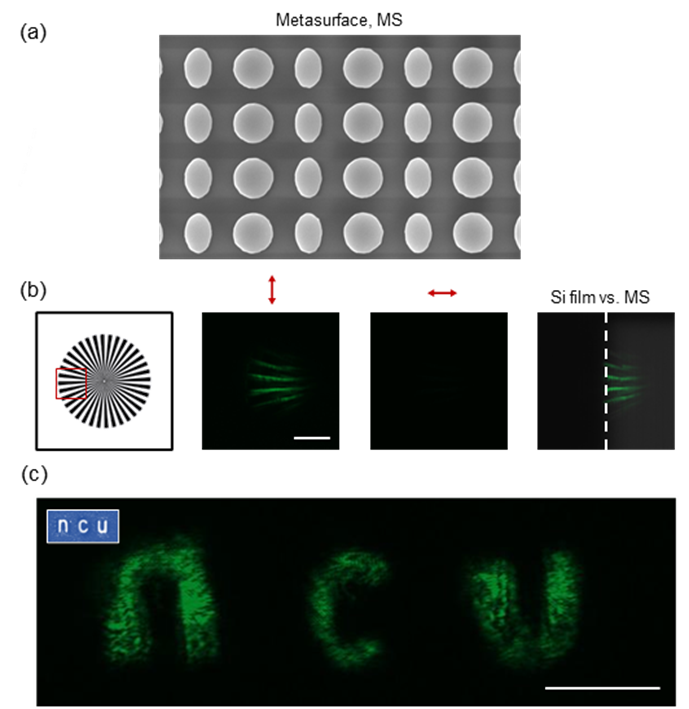
Measured IR upconversion imaging with the metasurface. (a) The scanning electron microscope image shows the unit cell of the metasurface used to make infrared light visible. (b) The Siemens star resolution target and its corresponding upconverted visible
Announcing a new publication from Opto-Electronic Advances; DOI 10.29026/oea.2026.250257.
SHANNON, CLARE, IRELAND, April 29, 2026 /EINPresswire.com/ -- Announcing a new publication from Opto-Electronic Advances; DOI 10.29026/oea.2026.250257.
Infrared light, invisible to our eyes, is essential for technologies like night vision, medical diagnostics, and industrial inspection. However, directly detecting it often requires complex, cooled, and expensive sensors. A brilliant workaround is to convert, or “upconvert,” this infrared light into visible light, where compact and highly sensitive silicon cameras excel. The challenge has been doing this efficiently in a miniaturized format.
Researchers from Nanchang University have now created a breakthrough solution: a smart, ultra-thin silicon chip called a metasurface. This chip is engineered with a precise array of nano-sized silicon disks. Its unique design triggers a powerful optical resonance, which temporarily confines and dramatically amplifies the incoming infrared light within the nanostructures. This intense light concentration supercharges silicon’s natural ability to generate new light frequencies. The result is an exceptionally efficient conversion: infrared light is transformed into visible green light through a nonlinear process called third-harmonic generation. The team achieves a record-high conversion efficiency for such a silicon metasurface. Crucially, they demonstrate practical imaging. When an infrared image is projected onto this chip, it produces a clear, high-resolution visible picture, successfully revealing fine details. This achievement paves the way for future compact, low-cost, and high-performance infrared imaging systems that operate at room temperature.
Advancing infrared imaging technology is vital for security, automation, and scientific discovery. However, conventional infrared detectors are hampered by material limitations, often requiring costly cooling and offering performance inferior to mature visible-light silicon sensors. Nonlinear upconversion imaging elegantly bypasses these detector issues by shifting the infrared scene into the visible spectrum, where superb silicon cameras can take over. Early upconverters use bulky nonlinear crystals with stringent alignment requirements, hindering miniaturization. Metasurfaces—nanostructured flat optics—emerge as a promising integrated platform. While they overcome the phase-matching constraint, their nonlinear conversion efficiency remains a critical bottleneck for practical use. The core scientific challenge is to maximize light-matter interaction at the nanoscale.
This work, led by Prof. Tingting Liu, provides a definitive solution by mastering a special type of resonance: the quasi-bound state in the continuum (quasi-BIC). The team designs a metasurface unit cell with paired silicon nanodisks and introduces a controlled, one-directional asymmetry. This clever design transforms a perfectly trapped, non-radiating optical mode (a BIC) into a high-quality, leaky resonance (a quasi-BIC) with a measured quality factor (Q-factor) as high as 4000. This high-Q resonance acts as a nanoscale light trap, creating a strong localized electric field that drastically enhances silicon’s third-order nonlinearity. Under infrared pump light, the metasurface achieves a remarkable third-harmonic generation (THG) efficiency of 3×10⁻⁵, setting a new performance benchmark for CMOS-compatible silicon metasurfaces and validating the power of tailored high-Q resonances. Beyond efficiency, the platform enables direct upconversion imaging. The metasurface acts as a parallel array of pixel-level converters. Any arbitrary infrared image projected onto it is faithfully translated into a corresponding visible image. The team demonstrates this with high fidelity, imaging test patterns and custom targets with a resolution of ~6 μm, all using a single pump laser at room temperature.
In summary, this research establishes a robust and scalable paradigm. By leveraging high-Q quasi-BIC resonances in a mass-producible silicon platform, it solves the key efficiency challenge of metasurface-based upconversion. This work is a significant stride toward deployable, miniaturized infrared imaging and sensing solutions for applications ranging from autonomous systems and industrial monitoring to next-generation consumer electronics.
Keywords: infrared upconversion imaging, nonlinear metasurfaces, bound states in the continuum, third-harmonic generation
# # # # # #
Tingting Liu, Ph.D., is an associate professor at Nanchang University. In recent years, her research has focused on the integration of signal processing and micro/nano-photonics, as well as key theories and technologies for light-field manipulation in subwavelength optical devices. She has presided over multiple research projects, including those supported by the National Natural Science Foundation of China and the Natural Science Foundation of Jiangxi Province. To date, she has published over 80 papers in renowned journals such as the Physical Review series, Nano Letters, Optics Letters, Optics Express, and IEEE Journal of Lightwave Technology. Her work has been cited more than 3,800 times, with an h-index of 29. She has been consecutively listed in Stanford University’s “World’s Top 2% Scientists” ranking in 2024 and 2025. Additionally, she serves as a frequent reviewer for high-impact international academic journals.
# # # # # #
Opto-Electronic Advances (OEA) is a high-impact, open access, peer reviewed SCI journal with an impact factor of 22.4 (Journal Citation Reports 2024). OEA has been indexed in SCI, EI, DOAJ, Scopus, CA and ICI databases, and expanded its Editorial Board to 41 members from 17 countries.
# # # # # #
More information: http://www.oejournal.org/oea
Editorial Board: http://www.oejournal.org/oea/editorialboard/list
All issues available in the online archive (http://www.oejournal.org/oea/archive).
Submissions to OEA may be made using ScholarOne (https://mc03.manuscriptcentral.com/oea).
ISSN: 2096-4579
CN: 51-1781/TN
Contact Us: oea@ioe.ac.cn
Twitter: @OptoElectronAdv (https://twitter.com/OptoElectronAdv?lang=en)
WeChat: OE_Journal
# # # # # #
Liu TT, Qiu JM, Qin MB et al. High-efficiency infrared upconversion imaging with nonlinear silicon metasurfaces empowered by quasi-bound states in the continuum. Opto-Electron Adv 9, 250257 (2026). DOI: 10.29026/oea.2026.250257
Opto-Electronic Advances Editorial Office
Opto-Electronic Advances
+86 591 2286 1222
email us here
Legal Disclaimer:
EIN Presswire provides this news content "as is" without warranty of any kind. We do not accept any responsibility or liability for the accuracy, content, images, videos, licenses, completeness, legality, or reliability of the information contained in this article. If you have any complaints or copyright issues related to this article, kindly contact the author above.
